
Commercial cabling is the physical foundation of every modern business network. From Cat6A copper runs to fiber optic trunk lines, the cabling infrastructure a company chooses directly affects network speed, reliability, and long-term scalability. BlueStar Technologies helps businesses select and install the right cabling system for their specific environment.
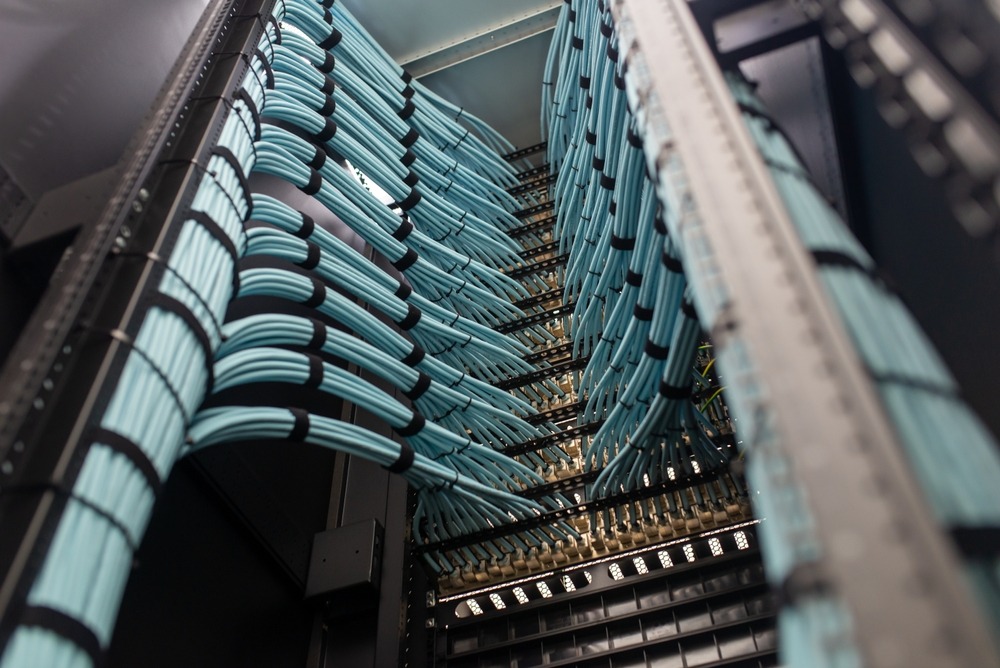
Every smart building, connected campus, and high-performance office has one thing in common: a well-designed cabling infrastructure running quietly behind the walls. Without it, even the most advanced wireless networks, VoIP systems, and cloud platforms struggle to perform. As organizations accelerate digital transformation and adopt technologies like IoT, AI-driven operations, and hybrid work models, commercial cabling has moved from a background consideration to a front-line business decision.
BlueStar Technologies works with commercial clients across industries to design, install, and maintain cabling systems built for the demands of today—and the demands of tomorrow. Whether a business is moving into a new facility, expanding an existing network, or upgrading legacy infrastructure, understanding the available cabling options is the first step toward making a smart investment.
What Is Commercial Cabling and Why Does It Matter in 2026?
Commercial cabling refers to the structured network of cables, connectors, and hardware that carries data, voice, and video signals throughout a building or campus. Unlike residential setups, commercial cabling systems must support hundreds—sometimes thousands—of simultaneous connections, all while maintaining signal integrity, minimizing latency, and complying with industry standards such as ANSI/TIA-568 and ISO/IEC 11801.
With hybrid work now a permanent fixture for many organizations, and with bandwidth-hungry technologies like 4K video conferencing, cloud-based ERP systems, and connected security cameras becoming standard, a properly designed cabling infrastructure is no longer optional. It is the foundation on which every other technology investment depends.
Copper Cabling: The Reliable Workhorse of Commercial Networks
Copper cabling remains the most commonly deployed medium in commercial environments, particularly for horizontal runs connecting workstations, access points, and IP phones to network switches.
Cat6 vs. Cat6A: Which Copper Standard Is Right for Your Business?
Category 6 (Cat6) supports data speeds up to 1 Gbps at distances up to 100 meters, making it a solid choice for standard office environments where bandwidth demands are moderate.
Category 6A (Cat6A) raises the ceiling considerably—supporting 10 Gbps speeds at the same 100-meter distance. For businesses deploying Power over Ethernet (PoE) devices, such as wireless access points, IP cameras, and smart lighting systems, Cat6A is the recommended standard. Its enhanced shielding also reduces crosstalk in dense cable environments.
BlueStar Technologies typically recommends Cat6A as the baseline for new commercial installations. The incremental cost over Cat6 is modest, but the performance headroom it provides is substantial—particularly as PoE and 10-gigabit applications become increasingly common.
Cat8: High-Density Data Center Applications
Category 8 (Cat8) is designed for data center use rather than general office deployment. Capable of supporting 25 Gbps and 40 Gbps speeds over shorter distances (up to 30 meters), Cat8 is ideal for connecting servers, storage systems, and top-of-rack switches within data center environments.
Fiber Optic Cabling: Built for Speed and Long-Distance Performance
Fiber optic cabling transmits data as pulses of light rather than electrical signals, delivering significantly higher bandwidth and longer transmission distances than copper. For commercial buildings with large footprints—or campus environments spanning multiple structures—fiber is often the only practical solution.
Single-Mode vs. Multimode Fiber: Understanding the Difference
Single-mode fiber (SMF) uses a single light path and supports transmission over distances exceeding 40 kilometers. It is the preferred choice for inter-building connections, service provider handoffs, and any application requiring long-distance, high-bandwidth performance.
Multimode fiber (MMF) supports shorter distances—typically up to 550 meters for OM4 and OM5 grades—but at lower cost. Multimode fiber is well-suited for intra-building backbone runs and connections between floors or network closets.
The latest OM5 wideband multimode fiber supports wavelength-division multiplexing (WDM), enabling multiple data streams to travel simultaneously over a single strand. This makes OM5 a forward-compatible option for organizations planning to scale network capacity without replacing physical infrastructure.
Structured Cabling Systems: Organizing Complexity at Scale
Beyond individual cable types, commercial environments require a structured cabling system (SCS)—a standardized architecture that organizes all cabling, hardware, and pathways into a cohesive, manageable framework.
A properly designed structured cabling system from BlueStar Technologies includes:
- Entrance facilities — the point where external service provider connections interface with the building network
- Main distribution areas (MDA) — centralized points housing core switching and routing equipment
- Horizontal distribution areas (HDA) — intermediate distribution points serving individual floors or zones
- Work area outlets — the end-point connections for user devices and equipment
This tiered architecture simplifies troubleshooting, supports future upgrades, and scales cleanly as an organization grows—reducing the costly, disruptive rip-and-replace cycles that poorly planned installations often require.
Emerging Cabling Considerations: PoE, Smart Buildings, and AI-Ready Infrastructure
The commercial cabling landscape is evolving alongside the technologies it supports. Several trends are shaping how forward-thinking organizations approach infrastructure planning.
Power over Ethernet (PoE) expansion is one of the most significant drivers of cabling upgrades in 2026. As businesses deploy more PoE-powered devices—access points, security cameras, occupancy sensors, and digital signage—cabling systems must support higher wattage delivery without overheating or signal degradation. Cat6A and Cat8 are purpose-built for these demands.
Smart building integration is pushing cabling into new areas of commercial real estate. HVAC controls, automated lighting, elevator systems, and physical access control increasingly rely on IP-based connectivity, expanding the scope of structured cabling well beyond traditional IT boundaries.
AI-driven network management tools require low-latency, high-reliability physical infrastructure to function effectively. The analytics, monitoring, and automation capabilities these platforms offer are only as good as the cabling underneath them.
How BlueStar Technologies Approaches Commercial Cabling Projects
Every commercial cabling project BlueStar Technologies undertakes begins with a site assessment and capacity planning review. This process identifies current bandwidth requirements, projected growth, physical building constraints, and any compliance or industry-specific standards that must be met.
From there, BlueStar Technologies develops a cabling design that aligns infrastructure investment with business objectives—whether that means a straightforward Cat6A horizontal deployment or a hybrid fiber-copper architecture spanning a multi-building campus.
All installations follow ANSI/TIA and ISO/IEC standards, and BlueStar Technologies provides full documentation, testing reports, and manufacturer-backed warranties on completed systems. Post-installation support, moves-adds-changes (MAC) services, and periodic infrastructure audits are also available to ensure cabling systems continue to perform as the business evolves.
Building a Network That Grows With Your Business
Cabling decisions made today set the ceiling for what a network can support for the next 10 to 15 years. Choosing the right cabling system—matched to actual workload demands, physical environment, and growth trajectory—is one of the highest-return infrastructure investments a commercial organization can make.
BlueStar Technologies combines technical expertise with a disciplined project methodology to deliver commercial cabling systems that are clean, compliant, and built to last. For businesses evaluating their network infrastructure, the conversation starts here.
Contact BlueStar Technologies to schedule a site assessment and cabling consultation.